The Chernihiv Oblast region holds seventeen villages. It’s the smallest region in Ukraine and in 2022 ten of those villages were fully occupied by russian military personal,
Property was looted, livestock and domesticated animals were slain and all community and cultural buildings were damaged to varying degrees.
Yagidne is a peaceful village surrounded by forest within the Chernihiv Oblast region of Ukraine. It has pretty houses surrounded by tall grey fences, which some of the locals’ dislike due to their ‘prisonlike’ appearance, some houses look almost brand new and a seemingly state of the art solar lighting system shines down on the less than ten streets of the village
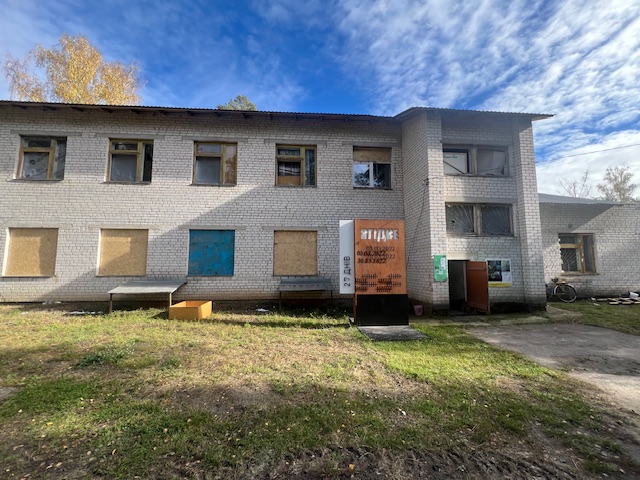
It also has a school; that is in a state of destruction.
When russia invaded Ukraine people moved back to their family homes in Yagidne thinking they would be safer in a small village away from the cities.
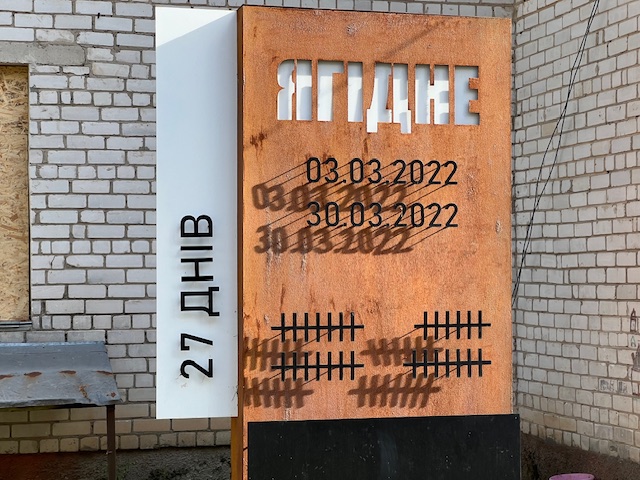
From Third March 2022 to the Thirtieth of March 2022 nearly 380 of the civilian population were held as hostages and human shields in two rooms of the basement of the Yagidne school.
The oldest was ninety-three and the youngest was just six weeks.
Ten prisoners would die in these rooms and a further eight residents died with the occupied village. One male was last seen being tortured by russian soldiers but his body has never been found.
There were rapes. There were murders. There was torture. There was starvation. There was a refusal to allow the burial of the dead until there were at least five bodies to be buried. So, the bodies rotted in the rooms with the living.
When the villagers where finally allowed above ground to bury their dead, they found themselves the target of russian shelling forcing, them to jump into the graves and lie on the deceased who had just been placed there.
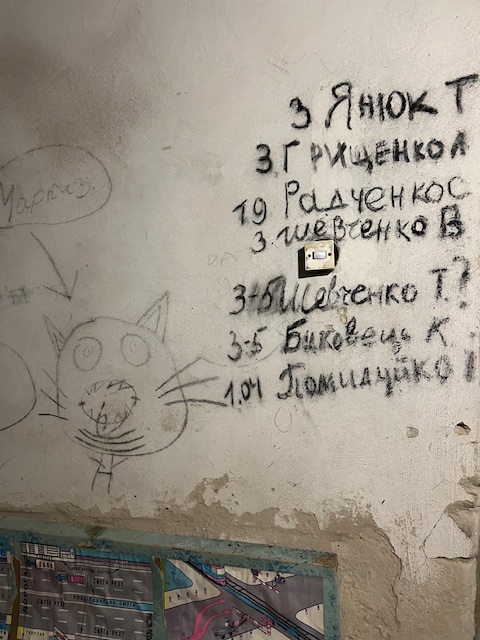
The names of the dead with the dates of their deaths are listed, written in charcoal around one of the basement doorways. One side lists those who died in the basement the other lists those the villagers knew had died above ground.
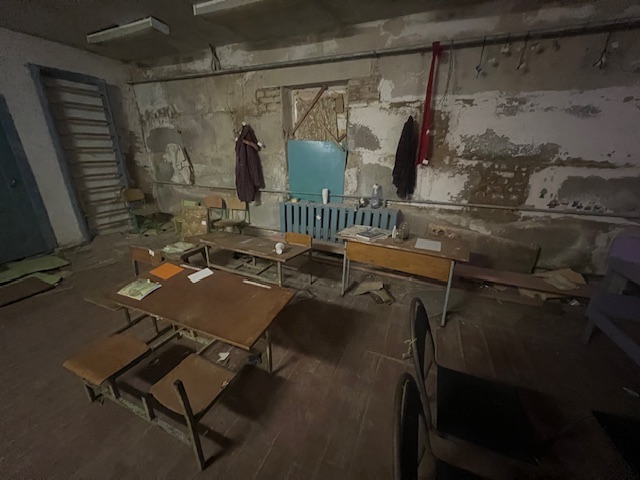
In the larger of the two rooms there ten people died. Lack of oxygen, no light, windows and little to know sanitation severely affected some of the elderly who slowly became insane before they died.
Begging for medicines food or water had no effect and, when eventually allowed up above ground the villagers found shots ringing out over their heads and into the ground around their feet.
The six-week-old baby, who had been underground and in pitch dark for so long could not open its eyes or face the outside daylight.
The smell of urine, faeces’, body odour and, vomit became unbearable. Some of the elderly became more and more immobile suffering sores from soiled underwear that was adhering to their skin.
One of the rooms had a wooden floor so small bunkbeds were made for the children, age eight to sixteen years old, to sleep on.
In the other room a flat table type area was made so the children could be off the floor and play in a ‘safe’ area.
One room had three buckets for toileting purposes the other only one. None of these were emptied in good time.
With just one cup of water, and half a cup of military ration type food per person per day Mothers would often forego food for themselves to give the children more food.
When one of the women approached a russian soldier to ask for help as people were dying, she was coldly told “people die-it’s war”
I was only in those rooms for a short time; with no more than twenty-one or two people. The place still smells. The dust creeps into one’s nose, throat, and sticks to the skin.
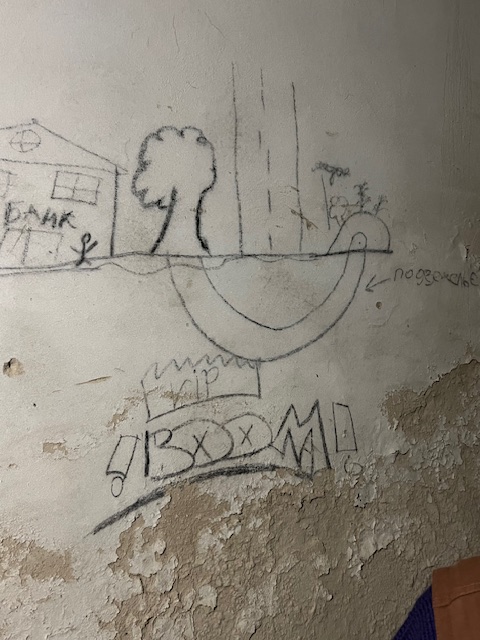
The rooms hold the writings and drawing of the children on the walls. There is more than one calendar and, as mentioned, the lists of the dead.
Objects that had been left down in the basements testify to man’s inhumanity to man. The occupants of one room were surprised to be given an electric light.
This was to allow them to read copies of the russian newspaper Pravda, the russian newspaper. Paper is always useful when sanitation is a bucket.
[to be continued]
 Liz In Ukraine
Leave a comment