For Part One, see here.
It’s interesting to note that there appear to be two spellings for the name of this town: Yagidne and Yahidne. The locals I spoke with pronounced it with a hard “g,” so that’s the spelling I will use.
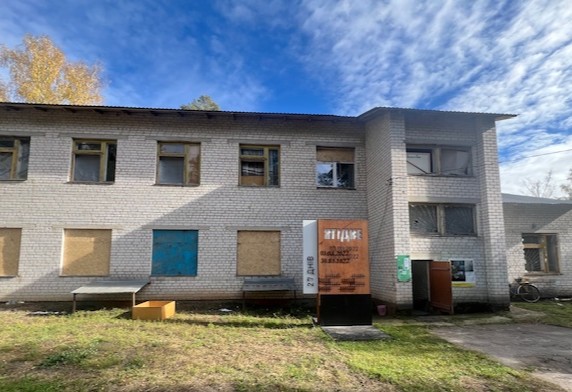
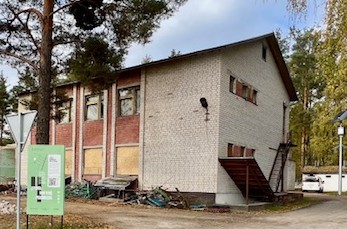
Back to a village where its history is quite literally painted on the doors and walls of the local high school.
The basement door bears a rough, hastily painted sign: “Children here.” It offered little protection from the brutality of a criminal occupying force.
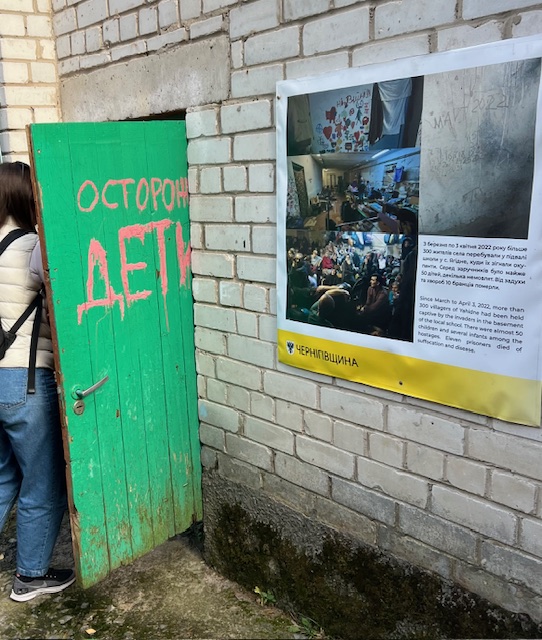
The calm presence and attention to detail from the survivors who guided us through those dark basement rooms was a testament to their dignity—and their determination that what happened to them, their families, and their fellow villagers will never be forgotten.
We were told how the rooms, initially cold and dusty, quickly warmed from the body heat of those forced into such cramped spaces. With little to no ventilation, the air became stagnant. This undoubtedly caused some of the elderly prisoners to lose consciousness, their minds, and in some cases, their lives.
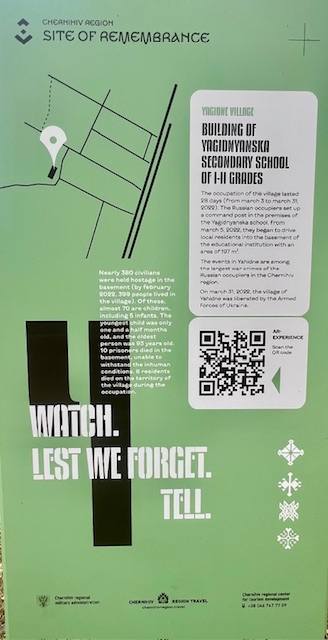
Valeriy was 38 when he, his wife, his parents, and his children were held with the other villagers. Nearly the entire population of Yagidne—367 people—was crammed into that basement. The youngest was just six weeks old, the oldest 93. They were used as human shields by the Russian forces, who shelled the surrounding area and Chernihiv with impunity, secure in the knowledge that Ukrainian defenders would not fire on their own people.
Later, two of my fellow travellers and I stayed with Valeriy’s parents. His father told us how, during Soviet times, he worked as a mechanic on MiG fighter jets, often in Moscow. He and his wife showed us family photos, including a wedding picture from when they were much younger—and had suffered less.
I sat in the front room with this remarkable couple who had opened their home to us. We used digital translators to hear more of their memories of that cellar.
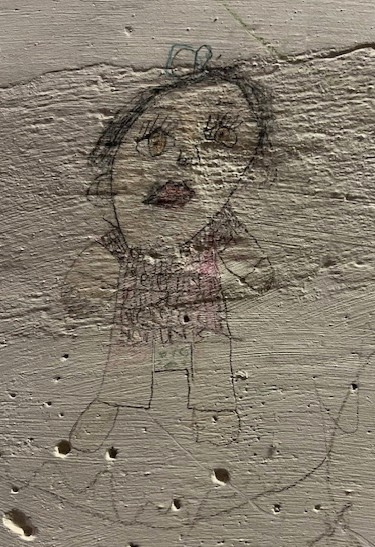
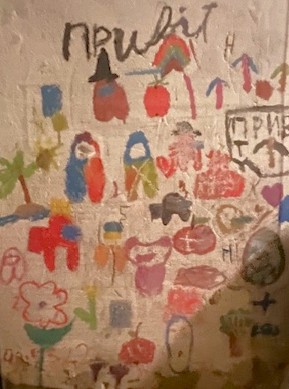
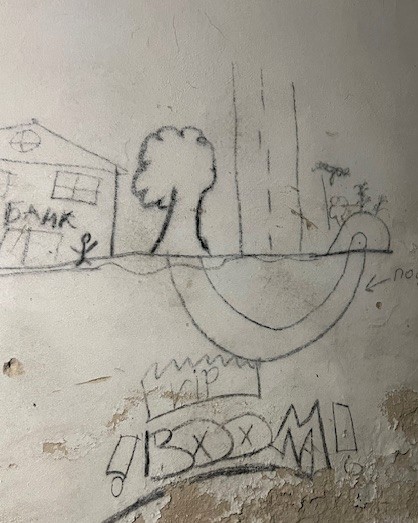
Looking around at the photos of smiling grandchildren, I couldn’t help but wonder: had these children been the artists behind some of the drawings on the cellar walls? Did any of the toys still left down there belong to them?

Looking at Valeriy’s parents, I was quietly stunned. Their fortitude was not loud or boastful—it was in the way they smiled, in the warmth of their welcome, in the courage it took to share memories that should never have had to be made. That they could speak of such darkness and still radiate joy was humbling.
To be continued…
 Liz In Ukraine